Mike Flanagan’s gothic series is filled with death, but its main concern is how the knowledge of dying might teach us to live.
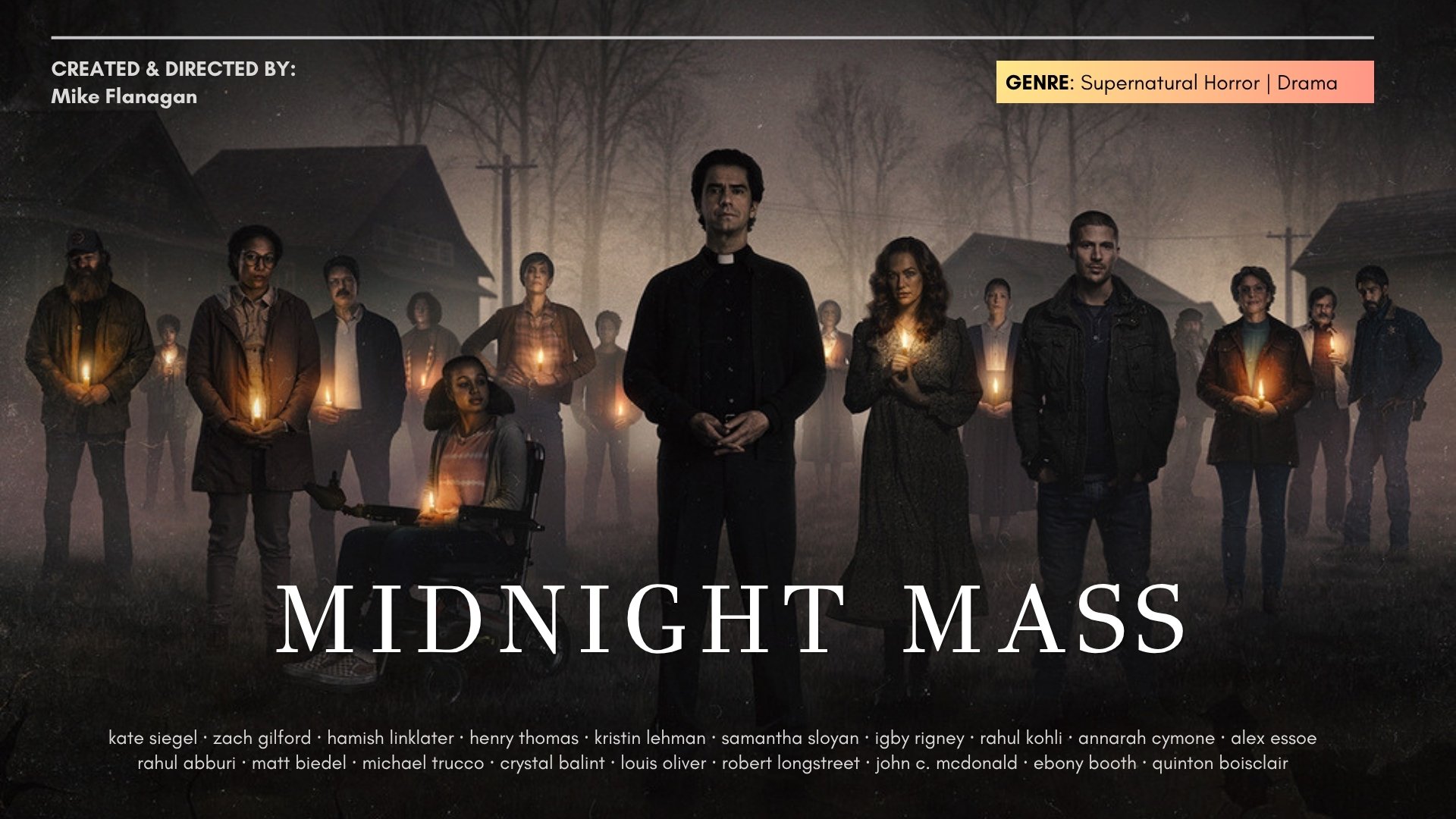
It’s the end of spooky season, and I’ve just finished my annual rewatch of Midnight Mass—a ritual of sorts.
Anyone who knows me knows I have a soft spot for gothic supernatural horror. Give me an old church, an isolated town, local folklore, an impossible creature, the quiet suspicion that something ancient is looming beneath the surface, and I’m sat.
At its best, gothic horror has never really been about the monsters for me. It’s about humanity. The supernatural gives us another language for examining our most ordinary fears, desires, and contradictions. A ghost can make grief visible. A curse can turn inherited harm into a compelling plot. A creature in the dark can reveal what people are willing to become when they believe they’re fighting evil.
When I first watched Midnight Mass in 2021, I was a newly inducted devotee of Mike Flanagan’s work. I expected a moving script, beautiful cinematography, and the cerebral, deeply atmospheric visual style I’d come to associate with him: lingering camera movements, negative space, and emotional tension instead of cheap jump scares.
What I got was all that and more.
The very first episode promised a slow-burning sense of dread, long conversations about faith and morality, and a story that left me sleeping with one eye open—all hallmarks of Flanagan’s work.
What I did not expect was to come away with a profound appreciation for life. That gratitude for being alive is hard-won for me.
I hope that does not sound as despairing as it might. I’m not saying it to invite sympathy or concern. I suspect more people feel this way than they’d like to admit.
That is the gift Midnight Mass has given me. For a story centered on so much death, it seems more interested in exploring what the certainty of death asks of those of us who are still here.
Being mortal
Most stories about mortality are concerned, in one way or another, with escape. They ask how death might be avoided, delayed, defeated, or made less frightening.
Midnight Mass asks a more difficult question: Since we know our lives are finite, what do we do with that knowledge?
How does the knowledge of death shape the way we love, forgive, create, and spend our ordinary days? What becomes urgent when forever is no longer available? What do we owe one another precisely because our time together is limited?
Philosophers and religions have wrestled with these questions for centuries. Every meaningful work of art eventually circles them—or at least the works I’m most drawn to.
Midnight Mass explores these questions through the lives of Crockett Island’s residents, a dwindling community burdened by poverty, isolation, private grief, and old resentments. Into this weary place comes the possibility of renewal—spiritual, physical, communal. What first appears to be grace gradually becomes indistinguishable from horror.
The series understands the appeal of that promise, and its characters make that appeal relatable. It does not treat the desire to overcome suffering as foolish. Its characters have lost health, family, opportunity, faith, and time. Of course they want restoration. Of course they are vulnerable to anyone who promises to return what has been taken.
The horror begins not with the desire for a miracle, but with what people become—and what they are willing to ignore—in order to keep believing in one.
Mild spoilers ahead…
In Episode Four, “Book IV: Lamentations”, Riley and Erin’s conversation about death and what comes after is one of the most beautiful explorations of mortality I’ve encountered on television. It brings me to tears every time, and it has also brought me a great deal of solace. If you can’t watch the scene, I recommend reading it instead. (See the excerpt here)
Riley and Erin offer different accounts of what they believe happens when we die. Neither tries to declare one vision correct; instead, they meet one another with tenderness in the face of the unknowable. That exchange contains, in miniature, the series’ larger message: faith is not valuable because it provides certainty, but because it gives form to hope.
The scene moves me because it doesn’t minimize death just to make life feel more vivid or immediate. It emphasizes the fact that knowing a moment will end does not make it meaningless. Its inevitable end is what makes the moment matter at all.
Faith, redemption, and the seduction of “righteousness”
Midnight Mass refuses to make the easiest argument available to it. Though Mike Flanagan—who like me, was raised religious and no longer is—could have made religion the villain and unbelief its antidote, he is more interested in the distinction between faith and certainty.
Faith makes room for mystery, doubt, and the possibility that we may be wrong. Certainty insists on being right, often at the expense of compassion and connection. The danger, the series suggests, is not belief itself, but belief that has stopped asking whether its consequences are loving.
Beverly Keane makes that danger painfully clear. Samantha Sloyan’s performance is extraordinary; I have to give her credit for making me hate Ms. Keane so intensely with such a painfully accurate portrayal. If you’ve ever been part of a church network, chances are you know a Bev Keane. She is terrifying not because she lacks a moral framework, but because she can bend it to justify whatever she already wants. Cruelty becomes discernment, exclusion becomes faithfulness, and when reality contradicts her, she reorganizes reality rather than reconsidering herself. Her certainty feels recognizable because we all know how easy it is to cling to being right, even when it costs us tenderness.
Yet, the story is remarkably generous toward people who fail, especially in ways that cannot be undone. Some of its characters cannot undo the harm they’ve caused, but they are not defined only by it. It shows that redemption is not about becoming flawless; it is choosing differently once we understand that we have failed. Accountability matters, but so does the possibility of change.
In a show about vampires and monsters, the most frightening transformations are moral before they are physical. It’s an accurate depiction of how, in a desperate search for hope and the false promise of a pain-free existence, people are willing to overlook harm and excuse cruelty until love becomes an abstraction that lets them stop seeing the suffering of those right in front of them—even members of their own community. Midnight Mass asks us not to abandon conviction, but to keep it humble enough to recognize another person’s humanity.
By the time the finale ended, I was thinking less about what happens when we die and more about the kind of person I want to be while I’m here. I wanted to call the people I love, be more gracious, and spend less time looking for certainty and more time just paying attention. That’s why I keep recommending this series. It brought me back to my own life and helped me see it more clearly. Knowing our time is limited doesn’t make life any less beautiful. If anything, that’s what makes it precious.