The Everythingness and Nothingness of “Orbital”
Samantha Harvey’s beautiful space novel considers the small rituals, restless longings, and fragile connections that make a human life matter
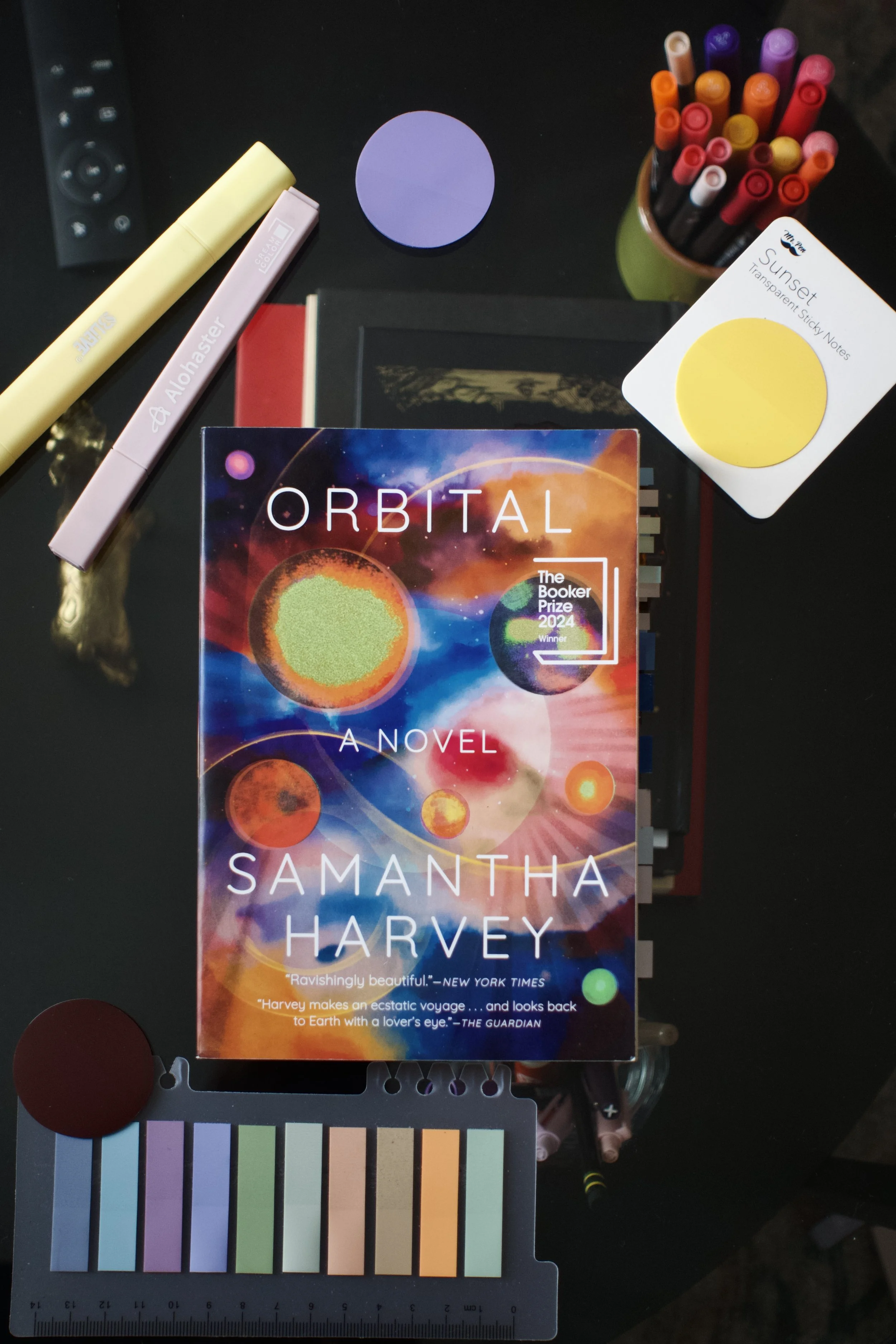
Orbital contains some of the most beautiful sentences I have read in a long time.
The novel follows six astronauts and cosmonauts through a single day aboard a space station. From America, Russia, Italy, Britain, and Japan, they travel more than 17,000 miles an hour as the earth turns silently beneath them, witnessing sixteen sunrises and sunsets.
Their circumstances are extraordinary, but their routines are surprisingly ordinary. They prepare dehydrated meals, exercise to keep their muscles from atrophying, float through gravity-free sleep, and exchange brief messages with the families they left behind. Photographs and small talismans keep the world personal. Their bonds with one another stand between them and utter solitude.
Most of all, they watch.
Continents, oceans, storms, and borders pass below them. From orbit, the earth is breathtakingly beautiful and strangely vulnerable: a silent blue planet carrying every war, marriage, disaster, ambition, meal, and private sorrow at once. Harvey moves beautifully between those scales. She looks at humanity from a distance vast enough to make us seem insignificant, then returns to the small habits through which we insist on mattering. A remembered voice. A family photograph. A meal eaten because the body must continue. A conversation that changes the texture of an hour.
This is the everythingness and nothingness I loved in the book. From space, an individual life is nearly invisible. From inside that life, everything matters.
Orbital pays close attention to our ability to create meaning from things that may appear pointless. We make hobbies, rituals, jokes, relationships, and moments of pleasure on a planet that will continue turning without us. Their smallness does not diminish their value. The apparently pointless things are, admittedly, the ones most worth living for.
It makes an excellent point: a life can’t be sustained by significance alone. We need small, unnecessary pleasures, familiar routines, and the company of people who change the texture of time. From far enough away, these details vanish. From inside a life, they are the life.
The novel is also perceptive about our constant desire to be elsewhere. We can spend years longing for a particular experience and begin missing its opposite as soon as we arrive. We seek escape, then ache for home; we want solitude, then feel the weight of separation. Even after achieving the rare dream of seeing the earth from space, the mind turns toward the small earthly lives continuing without it.
Their perspective has changed; their humanity has not.
That tension makes the book feel both expansive and intimate. The astronauts can see the planet almost whole, but they cannot escape the limits of being individual people with particular griefs, memories, loyalties, and desires. Distance grants a wider view without offering easy answers.
I also appreciated the novel’s lack of judgment. It observes human beings in all our vanity, tenderness, violence, creativity, and ridiculousness without reducing us to any one of those qualities. From orbit, our divisions can seem absurd; on earth, their consequences remain painfully real. Harvey allows both truths to exist at once.
My only real “difficulty” was the novel’s lack of plot. At times, I wondered whether these meditations might have carried even more weight as creative nonfiction—a real astronaut’s record of a day in space. The fictional characters occasionally felt less vivid than the ideas moving through them, and I found myself wanting more forward momentum.
But that reservation did not overwhelm what worked. Orbital is deliberately shaped by repetition: the station circles the earth, the crew completes its routines, and the planet offers new versions of the same impossible beauty. The form echoes orbit itself—constant movement that is also return.
More than anything, the book made the familiar strange again. It reminded me that the earth is both our entire world and one small object suspended in darkness; that human life is brief and crowded with meaning; and that we are held together as much by ordinary companionship as by grand purpose.
Orbital did not give me a conventional story, but it gave me something I value just as much: a different way of seeing. It made me look again at the planet, at other people, and at the tiny rituals through which we make a life.
For a book so interested in our smallness, it left me feeling that being here matters enormously.
Let me know what you think in the comments. 🤎
Happy reading, x!