Rufi Thorpe’s funny, daring novel follows a young mother who turns survival into an act of self-invention
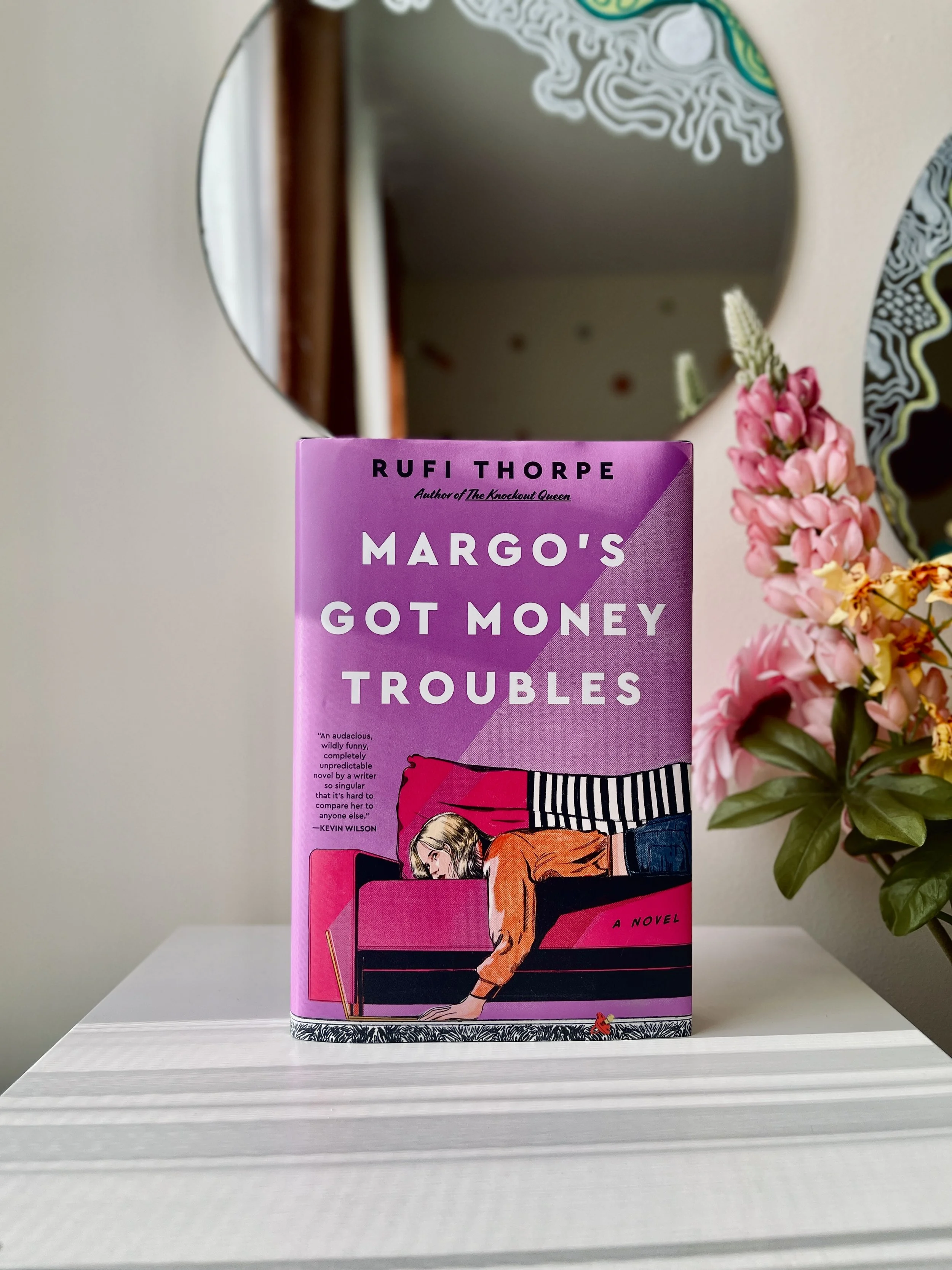
It’s always a pleasant surprise when a heavily hyped book actually delivers—because it often doesn’t. And Margo’s Got Money Troubles does.
Margo is raised by a Hooters-waitress mother and an ex–professional-wrestler father, and she’s has spent much of her life figuring things out on her own. She arrives at junior college without a clear plan, begins a brief affair with her married English professor, and then gets pregnant. Nearly everyone tells her not to keep the baby, but she does anyway.
That choice immediately reorganizes her life: she’s twenty, unemployed, caring for an infant, and watching the rent come due, while the systems around her offer plenty of judgment and very little practical support. So when her estranged father, Jinx, shows up and asks to stay, she agrees because she needs the childcare—and what follows is less reunion than two imperfect people figuring out how to be useful to each other.
With money problems growing more urgent, Margo starts an OnlyFans account. What starts as a desperate plan becomes unexpectedly successful when she applies lessons from Jinx’s wrestling career to her online persona—yes, professional wrestling becomes a business strategy for internet sex work.
What’s so sharp is how Thorpe frames all of this as self-invention. Margo’s Got Money Troubles transcends the familiar coming-of-age structure because Margo isn’t merely uncovering a true self that has been waiting inside her; she’s actively creating one through the way she responds to the world—becoming a mother by mothering, a businesswoman by solving the problems in front of her, and more independent not because she stops needing people, but because she learns to build support from the imperfect relationships available to her. The book’s larger argument seems to be that identity is not a fixed inheritance; it can be assembled from unlikely materials: mistakes, family history, economic necessity, and digital performance.
The novel moves between a third-person narrator and Margo’s first-person account, shifting perspective so smoothly the transitions feel almost invisible. It’s a daring choice—changes in narrative person can easily seem showy or distracting—but here, the technique deepens the book’s interest in performance and identity. We see Margo from the outside, as a character being observed and interpreted, and then we hear her claim the story from within.
I also think the shifts in POVs raise a quiet but important question: who gets to tell Margo’s story?
Everyone around her has an opinion about what her choices mean. To some, she is irresponsible. To others, she is a victim. Online, she becomes a persona. The shifting narration refuses to leave her inside any single version of herself. Margo is both the young woman others see and the person actively explaining herself to us.
Thorpe makes these transitions feel effortless, but the effect is significant. The form of the novel enacts what Margo is doing throughout the story: moving between the identities imposed on her and the identity she is creating for herself.
Margo is daring, but not because she is fearless. She is daring because fear does not relieve her of the need to act. She navigates work, money, motherhood, family, and public judgment with very little support at the beginning, all while caring for a child she fiercely loves. She makes mistakes, but she does not surrender authorship of her life to the people who disapprove of her.
I was in awe of how intentionally her character moves through the world. Her choices are not always safe or conventional, but they are hers. She accepts their consequences with more grace than the people judging her often deserve.
That is what stayed with me after finishing the book. Margo’s Got Money Troubles is funny, strange, compassionate, and genuinely inventive, but beneath all of that is a story about sovereignty. Margo’s circumstances give her very little control, so she becomes fiercely creative with what remains available. She does not wait for the world to approve of her life before she begins building it.
This was a fun read — and listen — a fantastic story about growing up, money, motherhood, performance, and the difficult work of making a self.
Have you read it? If so, let me know what you think in the comments. 🤎
Happy reading, x!