On Rotation
Shirlene Obuobi’s warm, messy debut asks what remains when the perfect immigrant daughter can no longer perfect her way through life
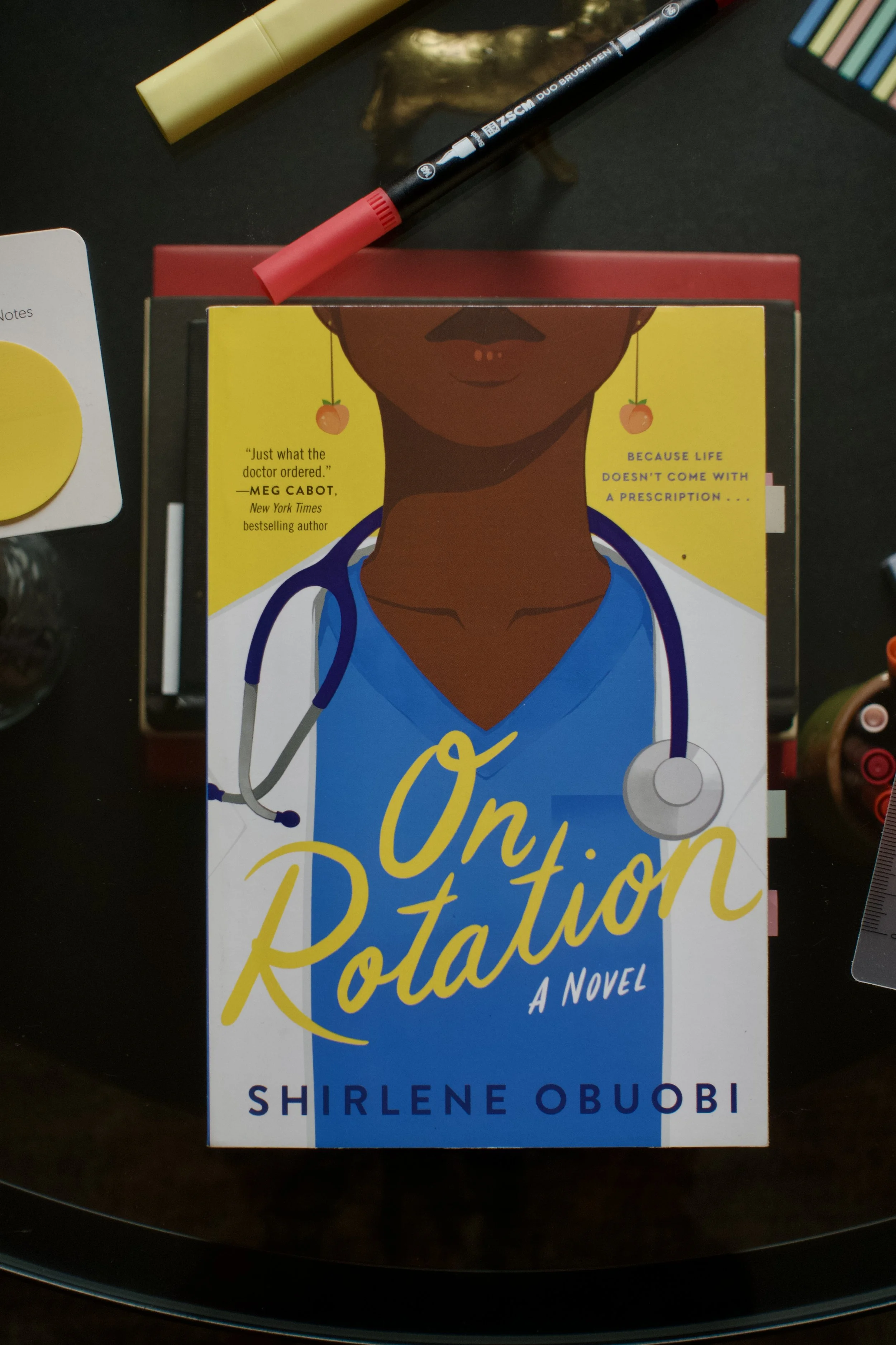
On Rotation didn’t hook me as quickly as Shirlene Obuobi’s second novel, Between Friends and Lovers. But once it did, I settled into Angie’s world and grew far more attached than I expected.
The novel follows Angie Appiah, a Ghanaian American medical student who has spent most of her life embodying the Perfect Immigrant Daughter: ambitious, disciplined, and exceptionally good at meeting expectations. Angie has built a life around achievement, and it works—until several parts of it begin collapsing at once.
She fails an important exam. Her boyfriend breaks up with her. Her friendships shift in ways she can’t control. Suddenly, the identity Angie has carefully constructed no longer feels secure.
For the first time, Angie is untethered—and has no idea who she is without a clear path to the next gold star.
Then she meets Ricky Gutiérrez in a public garden: charming, flirtatious, thoughtful, and almost suspiciously perfect. That suspicion turns out to be useful. Angie soon discovers he has a girlfriend. She tries to pull away, but their lives keep overlapping. Ricky volunteers in the pediatric ward where Angie is completing rotations; his best friend is connected to Angie’s social circle; and, somehow, they end up at the same Beyoncé concert. The universe—or the plot—seems committed to keeping him around.
The romance is central, but it never fully overtakes Angie’s internal story, which I appreciated most. On Rotation is really about perfectionism, burnout, and the terrifying possibility that your worth may not be tied to how well you perform.
Angie is so accustomed to succeeding that failure doesn’t feel like a setback; it feels like an identity crisis. Angie has learned to read achievement as proof that she is good, responsible, and deserving. When achievement stops cooperating, she has to confront how little space is left for being an ordinary person—confused, disappointed, occasionally selfish, and still worthy of care.
Obuobi is especially good at capturing how that pressure operates within an immigrant family. Angie’s ambitions are personal, but they’re also tied to sacrifice, gratitude, and the desire to make her family proud. Changing direction can feel like more than an individual choice; it can feel like wasting everything other people endured to make that choice possible.
The novel also understands that family expectations don’t have to be cruel to become burdensome. They can come from love, fear, pride, and a sincere belief in your potential—which makes them harder to resist. Angie isn’t simply trying to escape controlling parents; she’s trying to separate what she wants from what she’s become skilled at wanting on others’ behalf.
The medical-school setting gives that struggle real texture. You can tell Obuobi is writing from familiarity. The hospital scenes feel specific and emotionally grounded, and some of the book’s strongest moments come through Angie’s encounters with patients rather than her romance with Ricky.
Angie’s interactions with Ricky’s father, who struggles with heroin addiction, and with a teenage gunshot victim force her to look beyond grades and professional milestones. They return Angie to the human reason she wanted to become a doctor in the first place.
That distinction—between being good at medical school and becoming the kind of doctor Angie wants to be—is crucial. Angie has spent years pursuing the measurable version of success. Her patients remind her that competence also involves presence, empathy, and the ability to meet people in circumstances that can’t be solved by getting the correct answer on an exam.
I also loved the footnotes throughout the book. They explain medical terminology and Ghanaian traditions with wit and personality, rather than making the reader feel as though they’ve wandered into a textbook. The notes create a more intimate relationship with Angie’s voice, as if Angie is pausing the story to make sure we understand not only what happened, but the cultural and professional context through which she experienced it.
Tonally, On Rotation is extremely millennial romance—in the best way. It’s full of emotionally messy people trying to balance ambition, friendship, family expectations, mental health, and love, all while pretending they’re handling it better than they are.
Some of the plot beats are predictable, and I wasn’t always convinced the romance was the most interesting part of the book. Ricky is charming, but Angie’s evolving relationship with herself held my attention more strongly. The real love story is between Angie and the life she might build once she stops treating external validation as its foundation.
That’s where the novel succeeds most. Angie’s unraveling isn’t presented simply as a crisis to overcome; it becomes an invitation to reconsider the self she’s spent years perfecting. If the version of her life that looked correct from the outside can fall apart, perhaps she’s free to create one that feels more honest from within.
On Rotation is earnest, warm, funny, and vulnerable. It’s a romance, but it’s also a coming-of-age story about a woman learning that adulthood doesn’t arrive when you complete the right sequence of achievements. Sometimes it begins when that sequence fails—and you have to decide who you are without it.
What a fun read!
x, 🤎