“The Life of Chuck” Is a Life-Affirming Delight
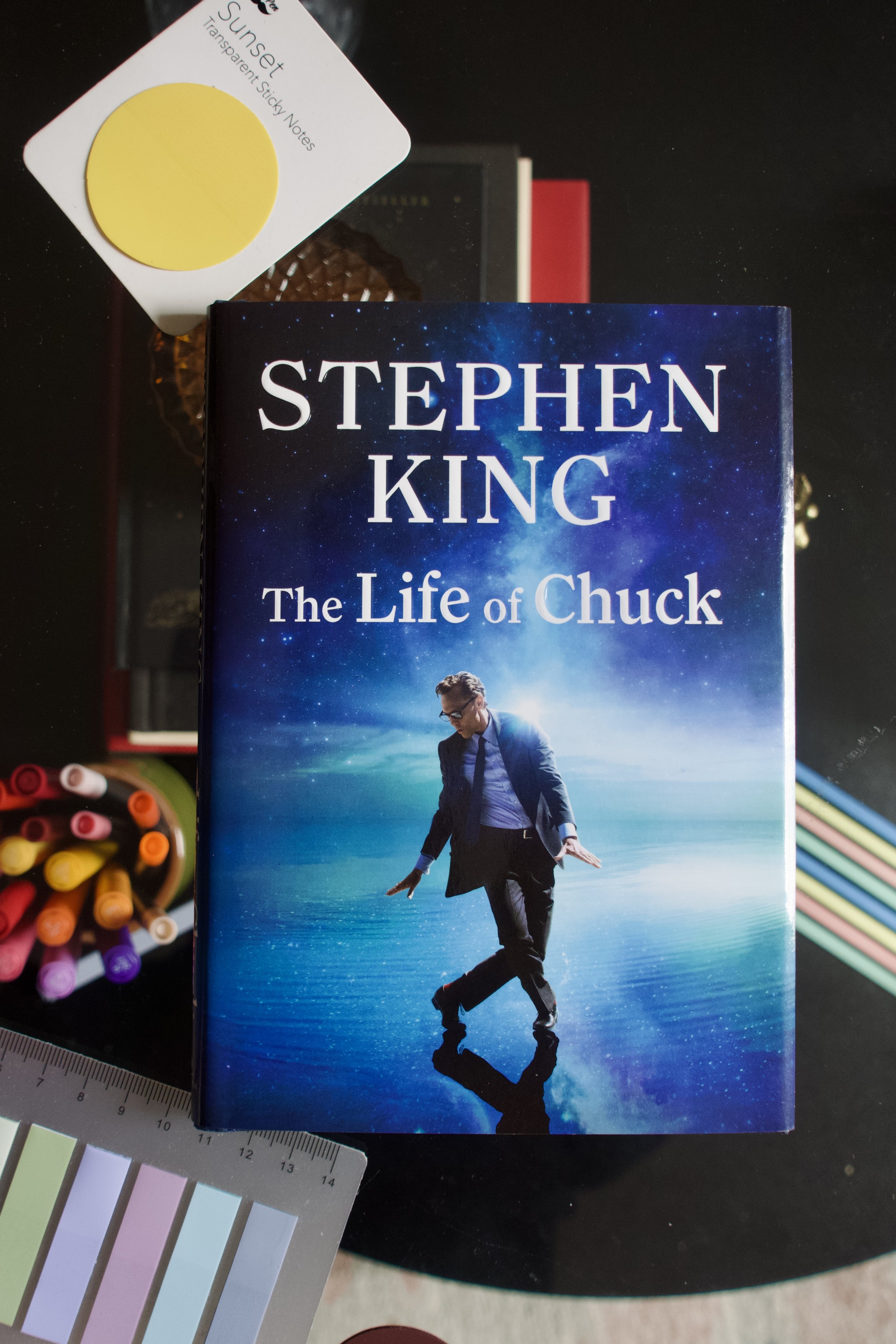
The basic proposition of The Life of Chuck is that every mind contains a world, and when a person dies, that world ends. Here, the world belongs to Charles “Chuck” Krantz.
King tells Chuck’s story in an unusual three-act structure spanning his thirty-nine years. It begins with the end of the world, moves through a life-affirming dance number, and concludes with a coming-of-age tale featuring a distinctly King-like magical realism element.
The first act offers a chilling portrait of a world in collapse: disasters multiply, coastlines sink into the sea, suicides surge, and the social order frays, while billboards and advertisements inexplicably thank a man named Chuck for “39 great years.”
“CHARLES KRANTZ….39 GREAT YEARS! THANKS, CHUCK!”
The later acts turn to the ordinary and extraordinary moments of Chuck’s life—a spontaneous sidewalk dance, the loss of his parents at a young age, lessons from his grandmother, and the mysterious upper room of his childhood home. In one heartwarming, indelible scene, Chuck’s young teacher explains Walt Whitman’s famous line “I am large, I contain multitudes.” It is one of many moments that transform a tale of relentless tragedy into an unexpectedly life-affirming story, revealing why one person’s end can feel like the end of everything.
The story’s reverse chronology immediately draws you in. Instead of watching Chuck’s life move toward its end, we begin there and discover the life that came before. It also invites us to consider what really matters. A sunny day, a song, a passing conversation—meaning does not have to come from a grand achievement. Sometimes, it is found in the smallest moments.
King is famous for horror, but this may be among his warmest works. It remains preoccupied with the fragility of reality and time, yet approaches that fragility with wonder. The result is a meditation on the smallness and vastness of a single existence—the multitudes inside Chuck and inside the rest of us.
The Life of Chuck is a sweeping portrait of an ordinary man’s time on Earth, exploring grief, fate, and what truly makes life worth living.
Mike Flanagan’s film adaptation understands this tenderness. I already love Flanagan’s work, particularly the way he uses horror to explore the human condition. Some of the monologues in Midnight Mass did not just move me; they affirmed how I understand my place in the world. His version of The Life of Chuck preserves the story’s generosity while remaining riveting and affecting. I highly recommend both.
xo,
Igho.