My 10 Best Books of 2025
Happy New Year! (again)
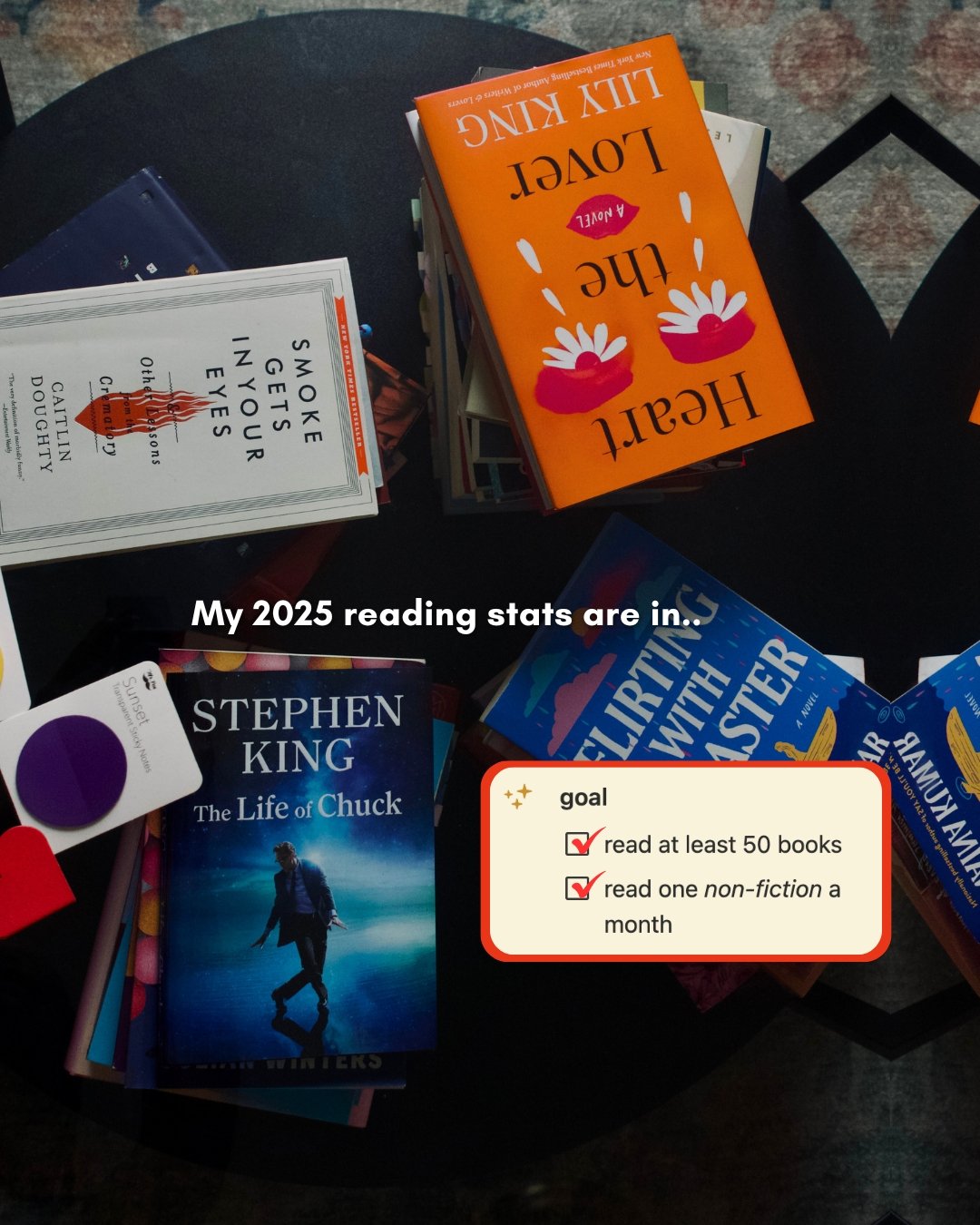
I read 57 books in 2025, enough to make choosing ten feel both satisfying and faintly absurd. Reading is not a competitive sport, despite what annual goals, BookTok, and color-coded trackers might suggest. A list like this is inevitably a record of attachment: these are the books I suspect will stay with me the longest.
For me, there is a difference between a favorite book and a great one. A favorite may be imperfect and still inspire fierce loyalty; a great book announces itself through the precision of its craft. Sometimes, luckily, the two overlap.
This list, then, is not a ranking. It is a map of my reading year—romance and horror, literary fiction and speculative strangeness, second chances and impossible grief.
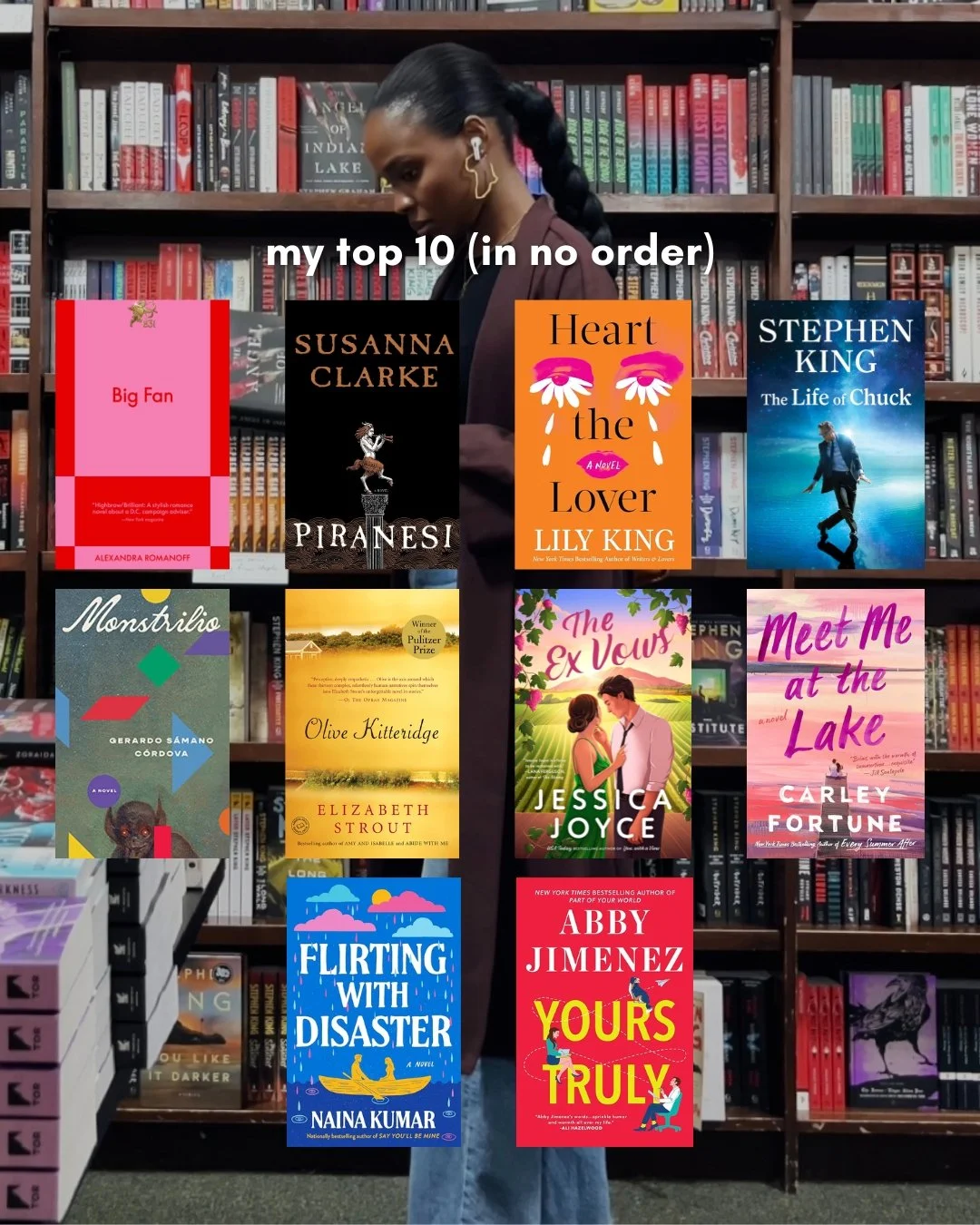
In no particular order, here are the ten books I couldn’t stop thinking about:

Yours Truly by Abby Jimenez
Briana is an ER doctor dealing with a recently finalized divorce, a brother in need of a kidney, and a promotion she believes has gone to Jacob, the awkward new doctor in her department. Their first encounters go badly, but then Jacob sends her a letter—sincere, apologetic, and unexpectedly charming. One letter becomes a correspondence, and antagonism gradually gives way to a beautiful friendship, trust, and intimacy.
I wrote about Yours Truly at length earlier this year, so I will not repeat the full case for it here. What made it one of my favorite books of 2025 was its gentleness: Jimenez treats anxiety not as a plot device to be overcome before love can begin, but as part of the practical architecture of a relationship—something that asks for patience, communication, accommodation, and care. Neither Briana nor Jacob is framed as the other’s renovation project. The fantasy is not perfection; it is being loved attentively, with safety made every bit as compelling as chemistry.
I loved it!
Big Fan by Alexandra Romanoff
I was in the middle of a huge reading slump when I picked up Big Fan, and it pulled me out of it. It’s a novella with a playful premise, and I expected something like polished self-insert fan fiction: a political strategist, recovering from a career-threatening scandal by association, reconnects with the boy-band idol of her adolescence. Now attempting a solo comeback, he needs her help. Naturally, complications ensue.
I would have enjoyed the simpler version of this story. I’ve lived through enough teenage boy-band crushes to know I’m exactly the target audience, but Romanoff does something more interesting. She asks what happens when the person you once idolized turns out to be an actual adult—complicated, appealing, and no longer safely contained within a fantasy (a true meet-your-heroes type-sitch).
The book is remarkably concise yet establishes so much: two convincing careers, two reputations in need of repair, and a relationship with enough tension to make the phrase “simmering with sexual tension” earn its keep.
It is smart, sexy, and economical. Also—and this matters more than it should—there is no cartoon cover. A win is a win.
Piranesi by Susanna Clarke
Piranesi requires trust—at least, it did for me. In its opening pages, Clarke places the reader in a world without coordinates. The narrator lives in the House, an apparently infinite structure of marble halls, statues, flooded chambers, birds, clouds, and tides. He catalogs its wonders in his journals and believes he is one of only two people alive there. The other is a man he calls the Other, who visits periodically to conduct mysterious research.
Clarke renders the House with extraordinary visual force. At first, I found the succession of halls and statues nearly oppressive; I almost stopped reading. But the repetition becomes its own form of enchantment. By the time the story begins to reveal the House’s secrets—and Piranesi’s—I felt that I, too, had learned its tides.
This is not a light book, though its darkness is subtle, like a dream that is hard to explain. The story grows increasingly unsettling: although Piranesi is imprisoned in—and perhaps by—the House, he loves it, and that devotion complicates the usual distinction between captivity and belonging. Ultimately, I was less interested in the machinery of the mystery than in the grace with which Piranesi meets what he comes to understand.
I almost DNF’d this book after five pages. I’m glad I didn’t.
Heart the Lover by Lily King
Heart the Lover is a decades-spanning, sort-of coming-of-age story told across two periods in its characters’ lives. The narrator, nicknamed Jordan by her classmates Sam and Yash, meets them during her senior year of college. She is quickly drawn into their friendship, which becomes a love triangle that shapes all three of their lives. Decades later, they meet again, facing the consequences of choices they made when they were young.
Brilliant. King explores how the heightened passions of youth harden into the regrets, compromises, and griefs of adulthood. I sometimes struggled to take the characters’ early romantic intensity as seriously as they did, but the novel’s devastating final reunion makes clear how deeply those choices have shaped Jordan’s life.
What stayed with me most was King’s refusal to romanticize or condemn desire: she writes with equal insight about creativity, restraint, regret, forgiveness, and the unsettling ways love can both anchor a life and expose its losses.
This was a short, wise, deeply moving novel, and I cried through what felt like half of the final act.
The Life of Chuck by Stephen King
The Life of Chuck unfolds in reverse across the thirty-nine years of Charles “Chuck” Krantz. It begins with a world collapsing under multiplying disasters while billboards inexplicably thank Chuck for “39 great years,” then moves backward through a spontaneous, life-affirming dance and into his childhood, where grief, his grandparents’ lessons, and a mysterious locked room shape the person he becomes. The unusual structure gradually reveals why the end of one ordinary life can feel like the end of everything.
What stayed with me was the story’s warmth. King is famous for horror, and the novel retains his fascination with mortality, the supernatural, and the fragility of reality, but it approaches them with wonder rather than dread. Through Chuck’s life—and Walt Whitman’s idea that “I am large, I contain multitudes”—the book finds meaning not in grand achievement but in a sunny day, a song, a dance, or a passing conversation. It is a tender, life-affirming meditation on grief, fate, and the smallness and vastness of a single existence.
Monstrilio by Gerardo Sámano Córdova
I read Monstrilio on an October trip after my boss recommended it. It wasn’t on my list—or even on my radar—and it was a treat.
After the death of her son, Santiago, Magos removes a piece of his lung and nurtures it as it grows. The creature becomes Monstrilio: first animal-like, then increasingly boy-shaped and capable of moving through the world as human. The novel follows his transformation while asking what grief permits, what parenthood demands, and what love becomes when it refuses to accept death’s finality.
The book’s great achievement is its refusal to make grief palatable. It is grotesque and tender, sometimes in the same sentence. Love here is not a clean, redemptive force. It is feral, protective, consuming, and occasionally destructive. What do we owe the dead? How far can we go to hold on to what we cannot accept losing? At what point does holding on become another form of harm?
I watch far more horror than I read—a gap I now feel compelled to fill.
Olive Kitteridge by Elizabeth Strout
Elizabeth Strout’s Olive Kitteridge is a collection of thirteen interconnected stories set in the small town of Crosby, Maine. At its center is Olive, a retired schoolteacher who is blunt, judgmental, perceptive, and capable of both cruelty and compassion. She moves in and out of the foreground as the town’s residents face crises both devastating and nearly invisible, their lives revealed in partial glimpses rather than neatly resolved narratives.
Strout’s true throughline in this story is its insistence that no person can be contained by a single account of who they are. We see Olive as she understands herself and as she is feared, resented, dismissed, loved, and remembered by others; none of these perspectives holds the whole truth, but each adds something essential. Precise, quietly funny, and deeply moving without becoming sentimental, Olive Kitteridge explores marriage, loneliness, aging, and grief while reminding us that ordinary lives do not need to be extraordinary to be significant.
The Second-Chance Romances
I grouped the final three books because they’re sisters-in-trope.
I understand the objection to second-chance romances: why root for a relationship that has already failed? Still, the trope is one of my favorites. When the original relationship was not abusive, one or both characters have not simply put their lives on hold, and the author—and the characters—are willing to examine what went wrong, the trope offers something a first-love story cannot. The second time around, the love story asks not only whether the lovers are compatible, but whether they have learned enough to love each other differently—to earn the “right” to their love story. The angst is too delicious to resist.
These three are examples of second-chance romance done RIGHT.
The Ex Vows by Jessica Joyce
Georgia and Eli were friends, then lovers, then exes. Now, they’ve been chosen to serve as best woman and best man at their mutual best friend Adam’s wedding. A week before the ceremony, disaster strikes: the Napa Valley venue burns to the ground and they have to team up and replan the entire event from scratch.
The novel is interested in more than nostalgia or residual chemistry. It explores emotional accountability: resentment, avoidance, the lingering effects of childhood wounds, and the ways a difficult upbringing can quietly shape what we believe we deserve from love. Georgia and Eli must reckon not only with the harm they caused, but also with the limits of what they understood at the time. Their reunion is not a return to innocence but a choice made with clearer eyes. That is what makes it moving: not the fantasy that love can conquer history, but the possibility that honesty and growth can change what history means.
I couldn’t put it down!
Meet Me at the Lake by Carley Fortune
A decade ago, Fern and Will spent one transformative day together and promised to reunite a year later. Will never showed. Now, Fern’s mother has died, leaving Fern responsible for the family’s struggling lakeside resort. Will reappears just as grief and duty have made her life unrecognizable.
The story alternates between their magical day together in the past and their messy, emotional reunion a decade later. But its emotional core is not the romance; it is Fern’s relationship with her late mother—the pain of learning more about a parent after she is gone and discovering too late how much they shared. Fern loved her mother, but love did not guarantee mutual understanding. Her grief is bound up in preserving a legacy without allowing it to determine her future.
Against this backdrop, Fern and Will try to understand what happened between them and whether it can be repaired. The book balances romance, grief, family obligation, healing, and self-discovery without making any of them feel decorative. Its prevailing atmosphere is longing—the ache of missed connections and accumulated almosts.
Flirting With Disaster by Naina Kumar
Meena, a high-powered lawyer, returns to Houston intending to divorce her estranged husband, Nikhil. A hurricane then forces them to shelter together in their former home. The literal storm leaves them with nowhere to go, while the emotional one—old injuries, unresolved desire, incompatible ambitions, and Meena’s almost-relationship in Washington—has been building for years.
The novel is a modern Sweet Home Alabama, reframed through Indian-American characters. That comparison captures the premise, but not the depth of Meena and Nikhil’s story. Career, family expectations, identity, and vulnerability take on added weight within cultural obligations neither character can simply set aside.
Meena and Nikhil have so much baggage—individually and together—that it’s a wonder either can stand upright. Their restraint made me want to shout, “Please, just talk.” Yet their interpersonal chaos feels earned. The book captures a stage of adulthood when love, work, and identity all seem slightly out of sync. It finds humor in that tension without trivializing it, and tenderness without suggesting that tenderness alone can solve everything.
Absolutely lovely!
I love romance deeply—books like these are why.
Honorable Mention
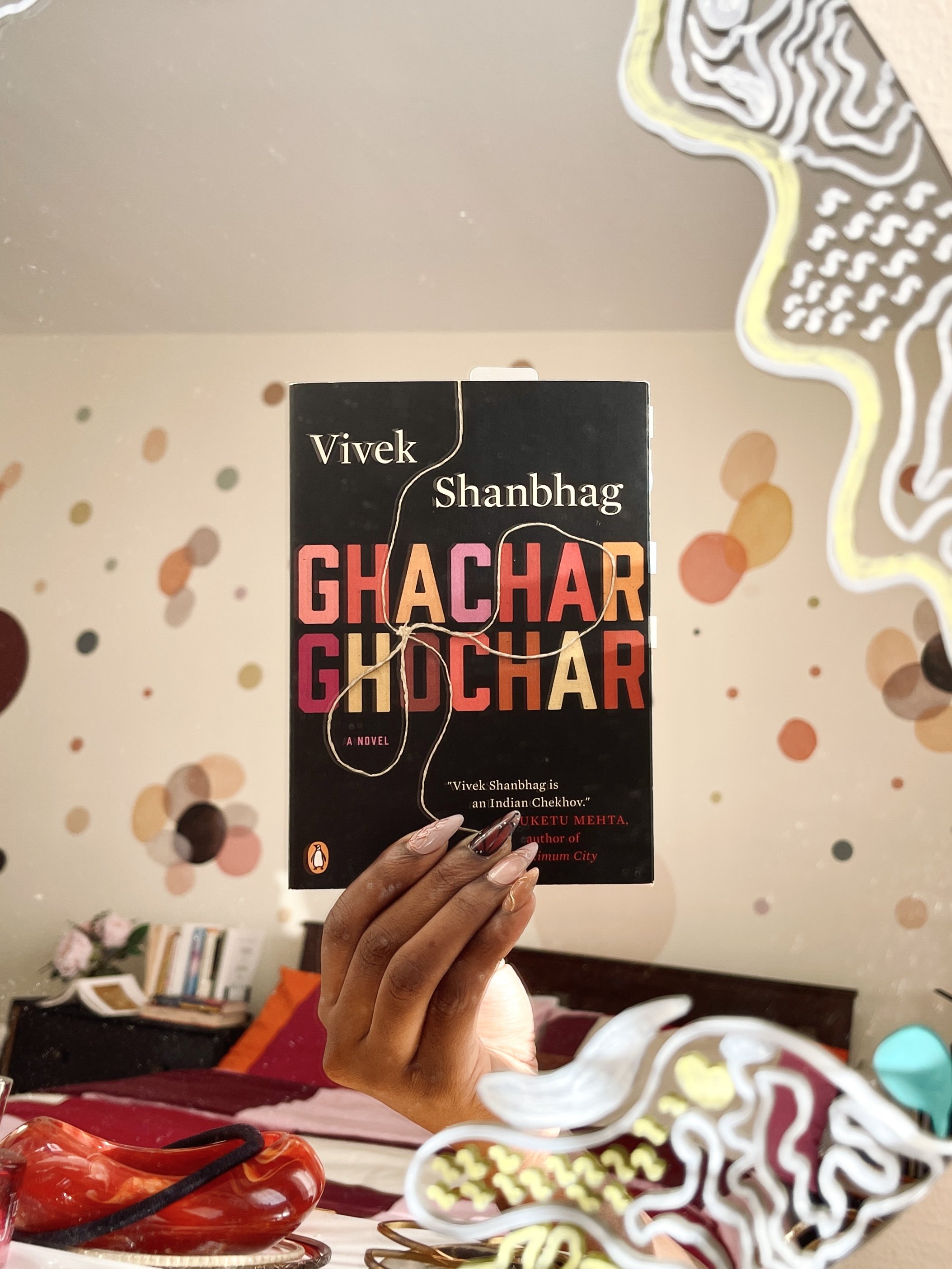
Ghachar Ghochar by Vivek Shanbhag
Originally written in Kannada, Ghachar Ghochar is a brief, unsettling novel about a Bangalore family whose circumstances change when an uncle’s spice business suddenly becomes successful. Money brings comfort, but it also rearranges the household’s balance of power. Old dependencies harden into new resentments; intimacy becomes surveillance; prosperity reveals rather than resolves the family’s moral compromises.
The novel is especially sharp on the way affluence can erode empathy while allowing everyone involved to call the result security. It understands the household as a system sustained partly by what its members agree not to see.
“It’s not we who control money, it’s the money that controls us. When there’s only a little, it behaves meekly; when it grows, it becomes brash and has its way with us.”
“The well-being of any household rests on selective acts of blindness and deafness.”
That second line could serve as the book’s thesis because its sentiment can be applied to the bulk of society’s ills. It may also be one of the most uncomfortably true statements I encountered last year.